
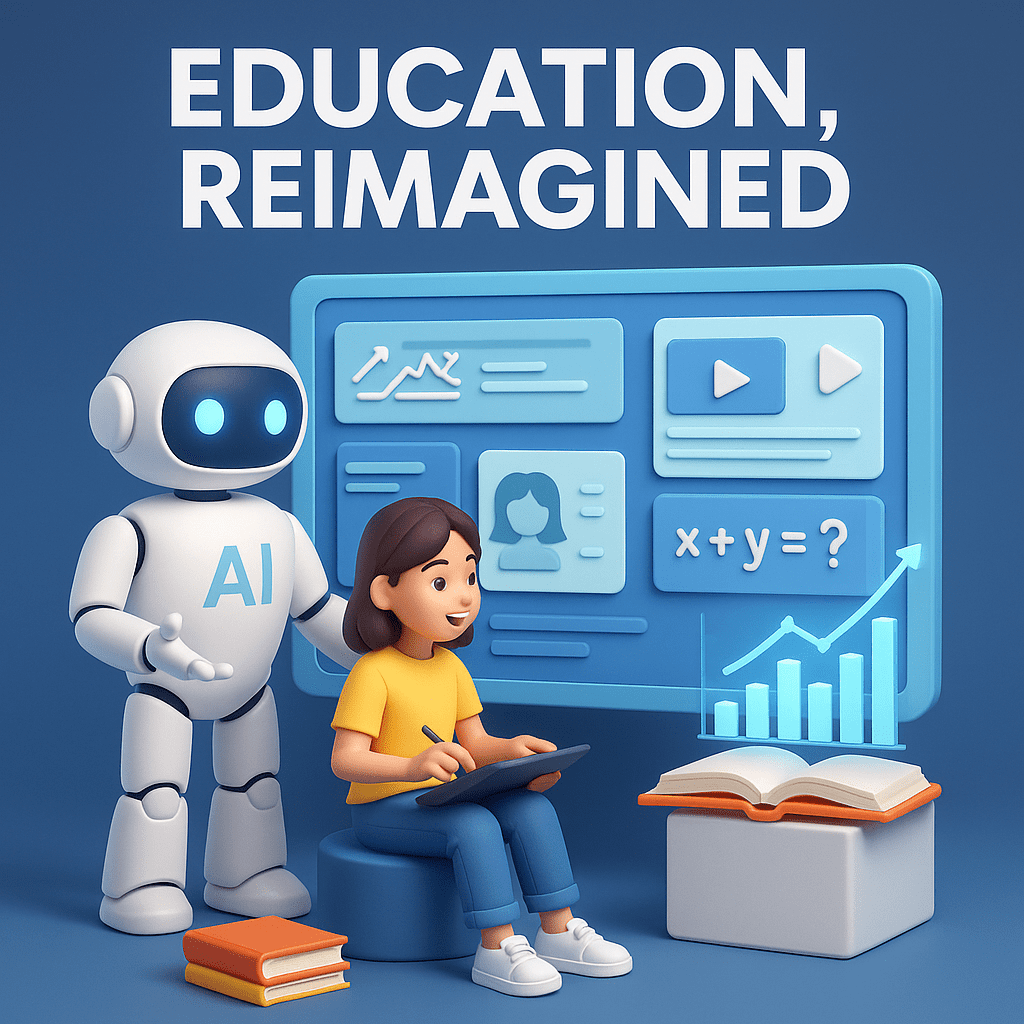

Education, Reimagined
In a world where change is the only constant, education hasn’t been left behind. If you’ve recently stepped into a modern classroom—physical or digital—you’ve probably sensed something different. The blackboards and overhead projectors are gone. In their place? AI-driven tools that talk, think, and learn with you.
Welcome to 2025, where artificial intelligence is more than a buzzword—it’s the backbone of a quiet revolution in how we learn, teach, and grow.
So, how exactly is AI transforming education in 2025? Let’s take a closer look—not just at the technology, but at the human experiences it’s reshaping.
Then vs Now: A Quick Look Back
To appreciate the leap, it’s worth remembering where we came from.
| Aspect | Education in 2015 | Education in 2025 (Now) |
|---|---|---|
| Personalization | One-size-fits-all curriculum | AI-driven adaptive learning |
| Teacher’s Role | Sole source of knowledge | Facilitator, supported by AI tutors |
| Assessment | Standardized testing | Real-time analytics and continuous assessment |
| Learning Format | Primarily in-person | Blended learning with virtual and AR tools |
| Student Support | Limited counselor access | AI chatbots, 24/7 mental health assistance |
Personalized Learning: No Two Students Are the Same
One of the most transformative changes we’re seeing is in personalized learning. AI platforms like Squirrel AI and Khanmigo are using real-time data to tailor lessons to each student’s pace, style, and interest.
Imagine a 9th-grade student struggling with algebra. Instead of waiting for the next math class or dreading a one-size-fits-all tutorial, their AI-powered platform recognizes the gap, adjusts the difficulty, and provides interactive videos, quizzes, and real-world examples that make sense to them.
It’s like having a tutor that actually gets you—and never gets tired.
Smart Classrooms: Learning Beyond the Walls
Today’s classrooms are smarter—literally. Smart boards sync with cloud-based lesson plans. Facial recognition tracks engagement (yes, your teacher knows when you’re zoning out). Even attendance is automated.
What’s fascinating, though, is the AI integration in rural or underserved areas. With tools like Google’s AI for Education, schools with minimal resources now access world-class materials. A student in a remote village in India can attend the same virtual AI-led science lab as a student in San Francisco.
In 2025, location is no longer a limit—it’s just a detail.
Teachers + AI: A Powerful Partnership
Despite fears early on that AI might replace teachers, the opposite is happening.
AI is becoming the ultimate assistant. It grades papers, summarizes student performance, and suggests remedial activities—freeing up teachers to focus on what they do best: teaching, mentoring, and inspiring.
A friend of mine who teaches high school English told me how AI now flags students who may be silently struggling—based on patterns in their writing, homework completion, or even behavior during class discussions. For her, it’s like having a co-pilot watching out for every student.
Teachers aren’t being replaced—they’re being amplified.
Continuous, Real-Time Assessment
Gone are the days of waiting anxiously for midterms or finals to know where you stand.
AI now enables continuous assessment, offering insights in real time. Platforms like Century Tech track student interactions, detect misconceptions early, and provide instant feedback.
For students, it removes the dread of surprises. For educators, it’s a goldmine of insights. You’re not just teaching—you’re iterating and evolving in sync with your learners.
Inclusivity and Accessibility
AI is playing a game-changing role in accessibility. Text-to-speech and speech-to-text tools, real-time translation, and visual aids are opening up education for students with learning disabilities or language barriers.
One standout example is Microsoft’s Immersive Reader, which helps students with dyslexia, ADHD, and other challenges read and comprehend content better. AI tools like these are making learning more inclusive—and a lot more humane.
Mental Health Support: A Quiet Lifeline
2025 is also seeing a deeper integration of AI in student well-being.
Chatbots like Woebot and AI companions trained in emotional intelligence now offer 24/7 support to students struggling with anxiety, stress, or loneliness.
They’re not a replacement for real counselors, but in a world where mental health resources are stretched thin, these tools are lifelines—especially in early intervention.
Ethical Concerns & Limitations: Not All Sunshine
Of course, this transformation isn’t without its challenges.
- Data Privacy: With so much student data being collected, concerns around privacy and security are real. Striking a balance between personalization and protection is key.
- Bias in AI Models: If trained on biased data, AI can perpetuate inequalities. Developers are now prioritizing fairness and transparency—but it’s an ongoing journey.
- Tech Dependency: There’s a growing need to teach students not just with AI but about AI. Digital literacy is becoming as essential as traditional literacy.
What’s Next? A Glimpse Ahead
Looking forward, the future feels even more immersive.
🔹 Augmented Reality (AR) will bring history and biology to life—imagine dissecting a virtual frog or walking through the streets of ancient Rome.
🔹 AI mentors will help students explore career paths based on their strengths, passions, and global demand.
🔹 Learning passports—AI-curated portfolios—will replace static transcripts, showcasing skills, projects, and growth over time.
The line between education and experience is blurring—and that’s a good thing.
Final Thoughts: It’s Not Just About Tech—It’s About People
In all this talk of AI and automation, it’s easy to forget that the heart of education is human. What AI is doing, at its best, is not replacing—but enhancing the connection between learners and knowledge, between curiosity and opportunity.
As someone who’s seen both sides—as a student overwhelmed by traditional systems and now as a tech enthusiast building smarter solutions—I believe the true power of AI in education lies in making learning more human, not less.
Let’s Keep the Conversation Going 🚀
How do you see AI transforming your learning or teaching experience in 2025?
Have you tried any tools that truly made a difference?
👇 Drop your thoughts in the comments or share this post with someone curious about the future of education.
Want to stay updated with more insights like this? Subscribe to our newsletter for the latest on EdTech, AI, and future-forward learning.



This is amazing content! Your expertise really shines through, and the way you present everything is so clear and engaging
Thanks🥰